Baby sleep schedules by age: a gentle, realistic guide
Search for a baby sleep schedule and you will find hundreds, all confident, most contradicting each other. It is worth saying plainly at the start: there is no single correct schedule, and the NHS does not publish one. Babies vary enormously, and the range of normal is much wider than the internet suggests.
What follows is a realistic picture of what tends to happen at each stage — not a target to hit. If your baby is feeding well, growing, generally content when awake and having plenty of wet nappies, their sleep is very probably fine, whatever the chart says.
How much sleep, roughly
Total sleep across a full 24 hours, including naps:
- Newborn (0–3 months): around 14–17 hours, in short bursts around the clock. Some healthy newborns sleep 11 hours, some 19.
- 4–6 months: around 12–15 hours, typically 3–4 naps reducing to 3.
- 6–12 months: around 12–15 hours, usually 2 naps.
- 1–2 years: around 11–14 hours, dropping to 1 midday nap somewhere between 12 and 18 months.
Notice how wide those bands are. A four month old sleeping twelve hours total and one sleeping fifteen are both entirely normal babies.
Newborn: no schedule, and that is correct
For the first several weeks there is no rhythm to find, because the circadian clock that produces one has not developed yet. Newborns do not know day from night. They wake to feed roughly every two to three hours, sometimes more often, and this is protective — frequent feeding supports weight gain and milk supply.
Do not try to build a schedule here. Do the two things that will lay the groundwork:
- Bright and busy by day. Feed in daylight, keep normal household noise, go outside.
- Dark and dull by night. Dim lights, minimal talking, straight back down after feeds.
That contrast is the single most useful thing you can do in month one, and it costs nothing.
3–4 months: a shape begins
Around now, a rough shape starts to emerge — a longer stretch at the start of the night, more predictable morning naps. This is also when the 4 month sleep regression usually lands, so expect the shape to appear and then temporarily fall apart. Both are normal.
A realistic day might run: wake around 7, nap mid-morning, nap early afternoon, a short late-afternoon catnap, bed somewhere between 6.30 and 8. Emphasis on *might*.
6–9 months: two naps and a real bedtime
Most babies consolidate to two naps — mid-morning and early afternoon — and night sleep lengthens. This is the age at which a bedtime routine starts genuinely earning its keep, because the baby is now old enough to recognise a sequence and anticipate what comes next.
Keep it short and identical: bath or wash, into sleepwear, a feed, a book or a song, into the cot. Twenty to thirty minutes is plenty. The predictability is the active ingredient, not the length.
Night waking at this age is still very common. Waking is not a sign that the routine has failed.
12–24 months: one nap
The morning nap drops away, usually between 12 and 18 months, and the day reorganises around a single midday sleep of one to two hours. The transition is often bumpy for a few weeks, with days that clearly needed two naps and days that clearly did not. Bridging with an early bedtime on the rough days helps more than forcing the nap.
Why a rhythm beats a schedule
A schedule says: nap at 9.30. A rhythm says: after the morning feed and some floor time, we nap.
Rhythms survive contact with real life — a late night, a clinic appointment, a growth spurt, a bad cold. Schedules break, and then parents feel they have failed at something. In practice, most families who describe themselves as having "a good routine" are running a rhythm and calling it a schedule.
The order stays the same. The clock moves. That is enough.
Safer sleep, at every age
This part does not flex. The NHS and The Lullaby Trust advise:
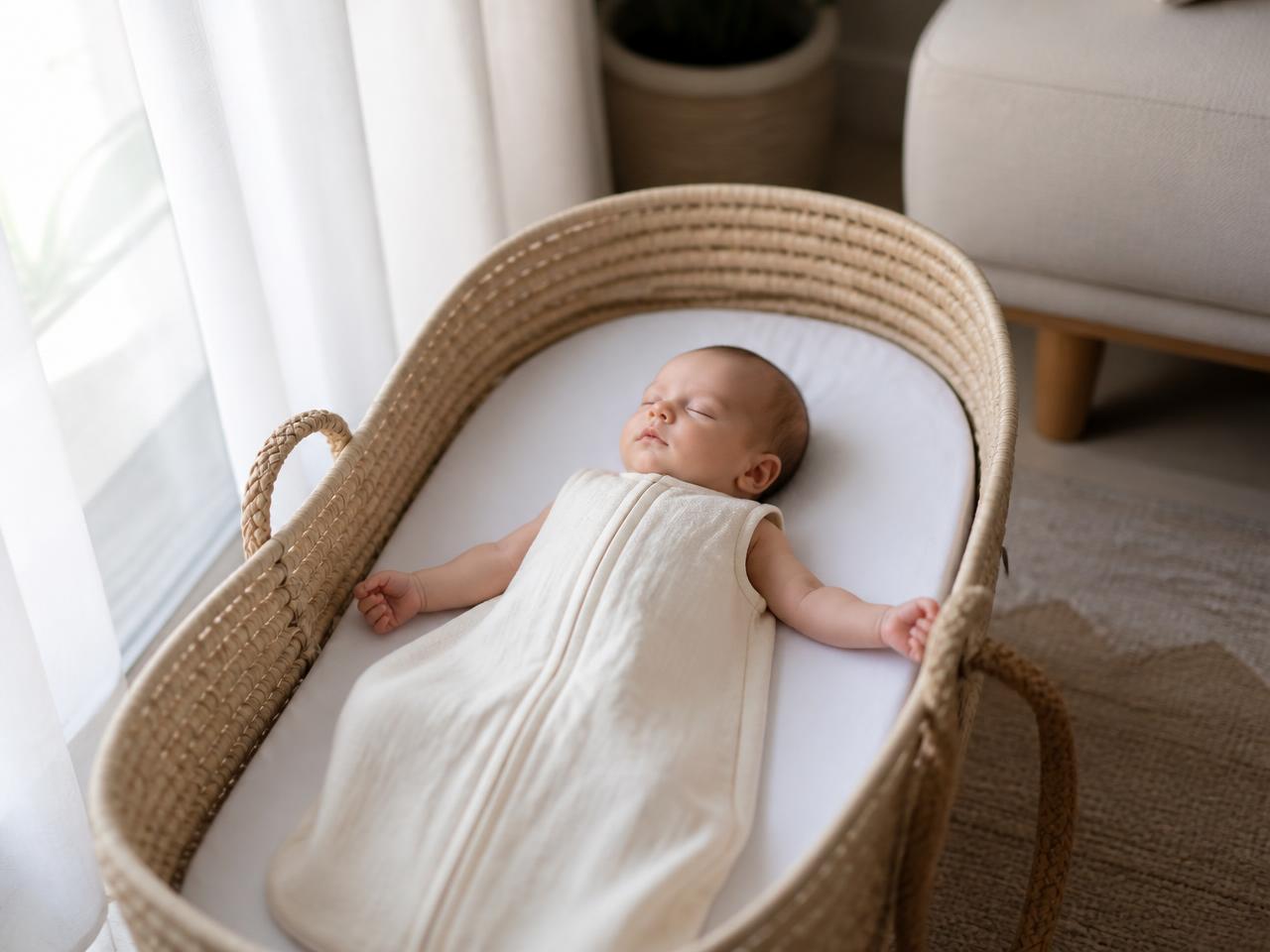
- On the back for every sleep, day and night, until your baby can roll both ways independently
- In a clear cot or Moses basket — no pillows, duvets, bumpers or soft toys under 12 months
- Feet to the foot of the cot, with any blanket tucked in no higher than the shoulders
- In the same room as you, for all sleeps, for the first six months
- Room temperature around 16–20°C
- A smoke-free environment, before and after birth
If you would like the full detail, The Lullaby Trust publishes it clearly and freely, and it is worth ten minutes of anyone's time.
The thing that actually predicts good sleep
Not the schedule. Consistency, daylight, and a parent who is not running on empty.
That last one gets left out of every article on this subject, so we will say it directly: your sleep matters too. A rota where each parent gets one unbroken block, rather than both being woken every time, is one of the highest-return changes a couple can make. If you are parenting alone, accepting one person's offer to take a 6am shift once a week is not weakness. It is strategy.
How Circle fits
Circle is a shared baby log built for exactly this — the working out of your own baby's rhythm, together, without anyone having to remember or relay it.
Everyone you invite — a partner, a grandparent, a childminder — sees the same live log of feeds, naps, nappies and medicine. Nobody has to ask "when did she last go down?", because it is on the screen. Naps and bedtimes log with a running timer and a "still sleeping" option, so the record is accurate even when you forget to come back.
From that history, Circle offers gentle nap and bedtime suggestions drawn from your baby's own logged pattern and age-typical ranges. We are careful with these. They are suggestions, not instructions, and we say plainly in the app that illness, teething, hunger and growth spurts all shift what a baby needs on any given day.
You can try all of it free for ten days, and it is £1.99 a month after that for your whole circle — not per person.
A last word
If you take one thing from this: the schedule is not the goal. A baby who is fed, safe, and responded to is the goal. Most families arrive at a workable rhythm eventually, and almost none of them get there by following a chart.
You are doing better than you think. The fact that you are reading about your baby's sleep at all says something about the kind of parent you are.
This article is general information, not medical advice. If you have concerns about your baby's sleep, growth or health, speak to your health visitor, GP, or NHS 111.